Kinesiology Taping: colourful strips, big claims - what does it actually do?
Claire Feldkamp
2/23/20263 min read
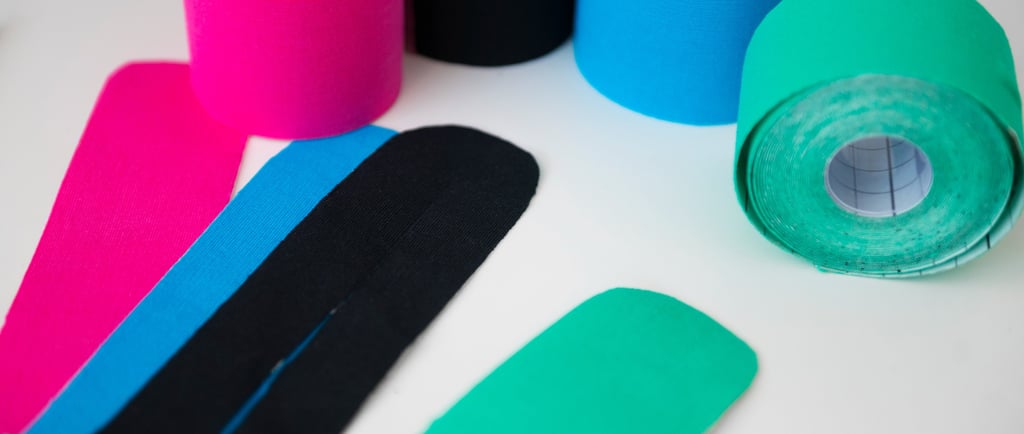
Walk into any gym, participate in a run or watch sports on TV and you’ll spot it instantly: bright blue, pink, or black strips of tape tracing lines across shoulders, knees, and backs. Kinesiology tape (often called KT tape) has become recognisable. But where did it come from, and does it genuinely help?
A quick history
Kinesiology taping traces back to the 1970s. Japanese chiropractor Dr. Kenzo Kase wanted a tape that behaved more like skin, something that could support muscles and joints without immobilising them. Traditional athletic tape was great for stabilisation but not ideal for maintaining full movement. He developed kinesiology tape, and it slowly gained traction in rehab and sports settings, then exploded into mainstream visibility once elite athletes started wearing it at major competitions. From there, KT tape leapt from professional sport into everyday life.
Unlike the rigid white athletic tape used to lock joints in place, kinesiology tape is elastic and flexible. It stretches, bends, and moves with your body. The idea is to offer a bit of support without restricting motion, which is why people often wear it for several days at a time - even while showering or exercising.
How is it supposed to work?
Depending on who you ask, kinesiology tape has been credited with everything from pain relief to improved performance. The most commonly discussed explanations include pain modulation through skin stimulation, improved movement awareness (proprioception), and a sense of support without restricting motion.
Some explanations you might hear,like dramatic ‘lifting of the skin’ to flush out toxins are controversial and not strongly backed by evidence. I certainly don’t believe that kinesiology tape flushes out toxins….
What do people use it for?
In everyday settings, kinesiology tape is most often used to help manage symptoms such as houlder discomfort, knee pain, sore calves, low back tightness, and general support during sport. It’s also sometimes used in clinical environments for swelling management or alongside lymphedema treatment.
What does research actually say?
The honest answer is that research results are mixed. Many studies suggest kinesiology taping can help with short-term pain relief, but the effects are usually small. In quite a few trials, the tape performs similarly to placebo taping. Systematic reviews show modest benefits for some shoulder and knee conditions, minimal clinical impact for low back pain, and limited effectiveness for reducing acute swelling.
So why do some people swear by it?
Even when measurable effects are small, kinesiology tape can still feel helpful. If tape reduces discomfort enough that you move more confidently, stick with rehab exercises, or stay active instead of avoiding movement, then it’s serving a useful role. Pain is complex, and perception and confidence matter. Sometimes the tape is enough of a neurological nudge’ in the right direction.
But kinesiology tape is best viewed as a helper, not a healer. It might take the edge off pain or make movement feel safer, but it’s unlikely to fix the root cause of an injury by itself. Long-term improvement usually comes from a combination of bodywork, strength training, gradual loading, and consistent habits.
Kinesiology tape isn’t magic — but it isn’t useless either. For some people, it provides short-term relief and confidence. And as its generally harmless*, non-additive and easy to use, its a very useful tool for anyone who is struggling with pain or movement. I often use kinesiology tape with many of my clientsand belive it to be a very useful tool.
*Hypernmobile people, especially those with EDS need to be careful about the use of kinesiology tape, as their skin can he very fragile. In cases where fragile skin is present, the use of any adhesive tape must be assessed on a case-by-case basis.
References
Celik, D., Kaya Mutlu, E., 2020. The clinical efficacy of kinesio taping for shoulder disorders: A systematic review and meta-analysis. Journal of Back and Musculoskeletal Rehabilitation, 33(5), pp.813–821.
Ghozy, S., Dung, N.M., Morra, M.E., Morsy, S., Elsayed, G.G., Tran, L., Huy, N.T., Hirayama, K., 2020. Kinesio taping versus other therapeutic modalities for shoulder pain: A systematic review and meta-analysis. Clinical Rehabilitation, 34(5), pp.557–568.
Sheng, Y., Duan, Z., Qu, Q., Chen, W., Yu, B., 2019. Kinesio taping in treatment of chronic non-specific low back pain: A systematic review and meta-analysis. BMC Musculoskeletal Disorders, 20, 296.
Wu, W.T., Hong, C.Z., Chou, L.W., 2022. Effects of kinesio taping plus exercise therapy in patients with knee osteoarthritis: A systematic review and meta-analysis. Frontiers in Physiology, 13, 961264.
Luo, H., Li, Y., Liu, S., 2024. Effectiveness of kinesio tape in the treatment of patellofemoral pain syndrome: A systematic review and meta-analysis. Medicine, 103(26).
Nunes, G.S., de Noronha, M., Cunha, H.S., Ruschel, C., Borges, N.G., 2015. Kinesio taping does not decrease swelling in acute lateral ankle sprain of athletes: A randomised trial. Journal of Orthopaedic & Sports Physical Therapy, 45(9), pp.705–712.
Yang, M., et al., 2024. Effectiveness of kinesio taping for breast cancer-related lymphedema: A systematic review and meta-analysis. Supportive Care in Cancer.
Opening Hours
Wednesday 9.30am to 7pm
Thursday 9.30am to 7pm
Friday 9.30am to 7pm
Saturdays by appointment
Areas I serve
Macclesfield
Poynton
Stockport
Wilmslow
Alderley Edge
© Claire Feldkamp 2026 |Terms & Conditions | Privacy Policy | Sitemap